

Pakistan Welding Institute provides professional welding education and technical training for students and skilled workers who want to build careers in welding and fabrication industries. These institutes offer hands-on training in MIG, TIG, ARC, and industrial welding techniques along with safety standards and certification programs. Welding institutes in Pakistan help students develop practical skills required for local and international job opportunities.
What Is the Pakistan Welding Institute?
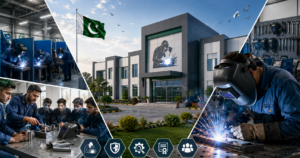
Think of PWI as Pakistan’s answer to the question: “Where do the best welders in the country actually learn their craft?”
Founded in 1995, the Pakistan Welding Institute sits inside a 50,000+ square foot campus at I-9/2 Industrial Area, Islamabad. It isn’t a private training centre chasing fees. It’s a government institution set up specifically to develop the human capital Pakistan’s industrial sector desperately needs.
PWI’s founding mission was bold and clear: reduce Pakistan’s dependence on foreign expertise for designing and fabricating critical industrial equipment pressure vessels, boilers, heat exchangers, and pipelines for oil refineries, fertiliser plants, and thermal power stations.
Thirty years later, that mission is still being delivered one certified welder at a time.
PWI’s Affiliation With PAEC and the IIW Why It Matters More Than You Think
Here’s something no other page on the internet explains clearly: PWI doesn’t just teach welding, it operates under one of Pakistan’s most powerful federal bodies.
PAEC the Pakistan Atomic Energy Commission is a federal government organisation responsible for Pakistan’s nuclear and energy programmes. When PWI sits under its umbrella, that’s not a footnote. That’s a trust signal that no private welding school in Karachi, Lahore, or anywhere else can replicate.
And then there’s the IIW angle.
Since 2000, PWI has been Pakistan’s official member of the International Institute of Welding the world’s largest welding standards body, with members in 59 countries. PWI is actively working toward becoming an Authorized National Body (ANB) and Authorized Training Body (ATB) under the IIW framework. That means PWI certifications are progressively aligning with globally recognised welding qualifications like the IWE (International Welding Engineer) diploma.
For you, that matters enormously especially if you’re eyeing a job in the Gulf.
Full List of PWI Courses Offered in 2025
PWI doesn’t just offer one or two generic welding classes. It runs a structured curriculum across multiple disciplines. Here’s what’s on the table:
Welding Technology Courses (Basic to Advanced)
These are your foundation-level and intermediate courses designed for welders, technicians, and engineers who want to master the core processes:
- SMAW (Shielded Metal Arc Welding) the most widely used process in Pakistan’s fabrication industry
- GTAW / TIG Welding precision welding for stainless steel, aluminium, and exotic alloys
- GMAW / MIG Welding high-speed production welding for structural and manufacturing work
- FCAW (Flux Cored Arc Welding) heavy-duty welding for construction and offshore applications
- SAW (Submerged Arc Welding) automated welding for large-scale fabrication
Welding Inspection & Quality Control
This is where engineers and quality professionals come in. PWI’s Welding Inspector courses run from Level Basic to Level Advanced, covering weld quality assessment, defect identification, and reporting. Eligibility typically requires an HSSC with Physics or a DAE in a relevant discipline.
Stainless Steel & Aluminium Welding
A specialist course targeting the food processing, pharmaceutical, and aerospace sectors industries where material contamination isn’t just a quality issue, it’s a safety one.
Laser Welding Technology
This one surprises people. No other welding institute in Pakistan offers dedicated laser welding training and PWI does.Laser welding is increasingly demanded in automotive, electronics, and precision manufacturing. Getting certified here puts you years ahead of most Pakistani welders.
Heat Treatment of Steels
Another gap in the market that PWI fills. Heat treatment is a critical post-weld process in pressure vessel and pipeline fabrication and understanding it separates good welders from exceptional ones.
PWI Course Duration & Eligibility 2025 Breakdown
This is the section everyone searches for and never finds in one clean place. Here it is.
| Cours | Duration | Eligibility |
| Welding Technology – Basic | 2 weeks | Matric with science |
| Welding Technology – Advanced | 3 weeks | Basic course or DAE |
| Welding Inspector – Level Basic | 3 weeks | HSSC with Physics or DAE |
| Welding Inspector – Level Advanced | 4 weeks | Level Basic + 2 yrs experience |
| TIG / GTAW Welding | 2 weeks | DAE or equivalent |
| Laser Welding Technology | 3 weeks | Engineering degree or DAE |
| Heat Treatment of Steels | 2 weeks | Engineering background |
| Welding Procedure & Welder Qualification (ASME) | 3 weeks | Engineering degree |
A few important notes:
- PAEC and NCA employees receive subsidised training support under institutional arrangements.
- Re-examination requirements and schedules are managed directly by PWI.
- Course structures and schedules are reviewed annually, so always confirm the latest details directly with before applying.
How to Apply for a PWI Welding Course Step by Step
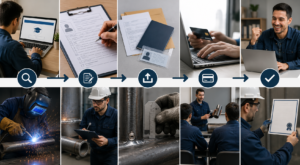
Applying to PWI is straightforward once you know the process. Here’s exactly what to do:
- Check the current schedule Visit pwi.org.pk and download the latest 2025 training calendar. Courses run in batches throughout the year.
- Confirm your eligibility Match your qualifications (Matric, HSSC, DAE, or degree) against the course requirements in the table above.
- Download the application form Available on the PWI website and at their Islamabad campus reception.
- Submit your documents Required documents typically include your educational certificates, CNIC, two passport photos, and the completed application form.
- Pay the course fee Payment is made via bank draft or direct deposit to PWI’s designated account. Confirm the current account details when you call.
- Receive your confirmation PWI will confirm your enrolment and provide the batch start date, timings, and campus reporting instructions.
Pro tip: Call PWI directly at their Islamabad office before submitting anything. Batch sizes are limited, and popular courses like Welding Inspector Level Basic fill up fast.
Is a PWI Certificate Recognized Internationally?
PWI’s IIW membership since 2000 gives its qualifications a degree of international standing that no other Pakistani welding institution can claim. In practical terms, PWI certifications are accepted across Pakistan’s oil and gas, construction, and manufacturing sectors and are recognised by employers in Gulf states including Saudi Arabia, the UAE, Qatar, and Kuwait, particularly for fabrication, pipeline, and pressure vessel work.
That said, some international projects and employers, especially those operating under strict codes like ASME, AWS, or CSWIP standards may require additional third-party certification on top of your PWI qualification. In those cases, your PWI training gives you a massive head start; you’re not starting from scratch.
Industries and regions where PWI-certified professionals regularly secure employment:
- Oil & gas fabrication Saudi Arabia, UAE, Qatar
- Power plant construction Pakistan, GCC countries
- Boiler and pressure vessel manufacturing regional and domestic
- Shipbuilding and heavy engineering Southeast Asia
- Chemical and petrochemical plants Gulf and domestic markets
As PWI progresses toward full IIW ANB/ATB status, international portability of its certifications will only strengthen.
PWI vs Other Welding Institutes in Pakistan Honest Comparison
| Institute | Affiliation | Certifications | International Recognition |
| PWI Islamabad | PAEC + IIW member | PWI, IIW pathway | Strong (IIW, Gulf industry) |
| TWI Pakistan (Lahore) | TWI UK | CSWIP 3.1, BGAS | Very strong (global) |
| Descon Technical Institute | Private | Descon internal cert | Domestic only |
| PITAC | Govt. | Basic trade certificates | Domestic only |
| Qanmos / QTTC | Private | In-house cert | Limited |
The honest verdict: If your goal is a career in Pakistan’s industrial sector or the Gulf, PWI is the strongest value proposition government-backed, IIW-affiliated, and a fraction of the cost of TWI Pakistan’s CSWIP programmes. If you’re targeting a senior inspector role on an international megaproject requiring CSWIP 3.1 specifically, budget for TWI as a follow-on investment after PWI.
Expert Insight: What Welding Professionals Actually Say About PWI
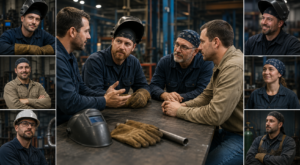
This is where the real story lives beyond the brochures.
A senior pipeline welder based in Karachi, with 11 years of experience across Pakistan and Oman, put it plainly: “PWI gave me the technical foundation no one else was offering in Pakistan at the time. The instructors knew their material this wasn’t classroom theory, it was industry practice.”
An engineering manager at a major EPC (engineering, procurement, and construction) company in Islamabad noted that PWI-certified welding inspectors consistently outperform candidates from smaller private institutes during practical assessments because PWI’s training methodology is anchored in actual industry codes like ASME Section IX and ISO 9606.
For readers considering their options: the PWI training environment is not cosmetic. The campus includes fully equipped welding workshops, a controlled-atmosphere consumable store (critical for maintaining electrode quality), lecture halls, an audio-visual laboratory, a technical library, and a dedicated conference room for industry collaboration. You’re not paying for a certificate you’re paying for infrastructure and expertise that took 30 years to build.
PWI Facilities: What to Expect on Campus
Walk onto the PWI campus and you’ll understand immediately why this isn’t just another training centre.
The I-9/2 Industrial Area campus spans over 50,000 square feet and includes:
- Fully equipped welding workshops SMAW, GTAW, GMAW, SAW, and specialist process bays
- Controlled-atmosphere consumable store proper electrode storage is critical for weld quality, and PWI takes it seriously
- Lecture halls for theory, code interpretation, and welding metallurgy sessions
- Audio-visual laboratory for practical demonstration and inspection training
- Technical library housing international welding standards, codes (ASME, AWS, ISO), and research material
- Conference room used for industry seminars, IIW coordination, and specialist workshops
This level of infrastructure is simply not available at any private welding institute in Pakistan. It’s one of the most tangible reasons why a PWI qualification carries weight with serious employers.
Conclusion
Joining a Pakistan welding institute is a smart step for anyone looking to gain technical expertise and career growth in the welding industry. Professional training improves welding skills, increases job opportunities, and prepares students for industrial work environments. With proper certification and practice, welders can build successful careers in Pakistan and abroad
FAQs
What is PWI and when was it established?
The Pakistan Welding Institute was established in 1995 under the Pakistan Atomic Energy Commission (PAEC) in Islamabad. It is Pakistan’s national body for welding training, research, and certification, and has been a member of the International Institute of Welding (IIW) since 2000.
How much does a PWI course cost in 2025?
PWI course fees range from approximately PKR 25,000 for basic welding technology courses to PKR 70,000 for advanced programmes like Welding Procedure & Welder Qualification under ASME standards. PAEC and NCA employees are eligible for subsidised rates.
Is a PWI certificate recognized in Saudi Arabia or the UAE?
Yes PWI certifications are accepted by employers in Saudi Arabia, the UAE, Qatar, and Kuwait, particularly in oil and gas, construction, and manufacturing. Some international projects may additionally require CSWIP or AWS certification, for which PWI training provides strong preparation.
What is the eligibility for the PWI welding inspector course?
The Welding Inspector Level Basic course typically requires an HSSC (FSc) with Physics or a DAE in a relevant technical discipline. The Level Advanced course additionally requires at least two years of relevant industry experience after completing Level Basic.
Is PWI a government institute?
Yes. PWI operates under the Pakistan Atomic Energy Commission (PAEC), a federal government body. This makes it the only government-backed welding training institute of its kind in Pakistan a distinction that carries significant weight with both domestic and international employers.
How long are PWI welding courses?
Most PWI courses run between 2 and 4 weeks, depending on the level and specialisation. Basic welding technology courses are typically 2 weeks; inspector-level and advanced programmes run 3–4 weeks. Full details are published in the annual training schedule on pwi.org.pk.